Showing posts with label forage. Show all posts

Thursday, April 7, 2016

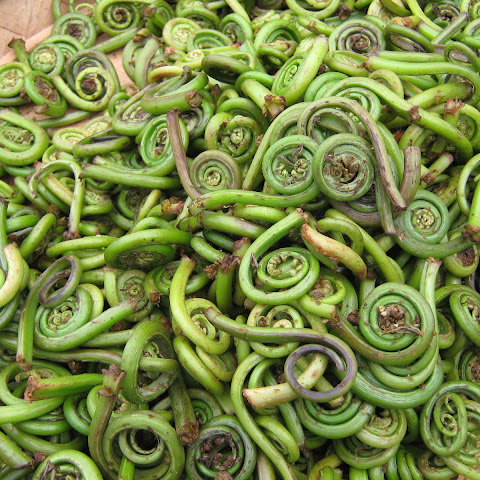
Foraging for Fiddleheads


I'm dragging you back to the woods and river banks for today's post. Today we are talking about FiddleHead Ferns and that's really lucky because they are a spring time gourmet wild Vegetable!
I've been checking around our area and I think I may have just missed them for this year. The weather has been very strange, way too hot for April and tonight it's dropping back down to freezing temps, so I'm still on the hunt.

This is what your looking for  :


Fiddleheads, yeah it's a strange name but once you see them you totally get where it's coming from. The tightly coiled shape resemble the scroll of a violin or fiddle if you rather. 

They are the emerging sprouts of wild ferns, most often on the east coast our variety of choice is Ostrich Ferns. They have a taste that could be compared to asparagus. Generally they are seen from April to June, depending on the weather. They can sometimes be found at farmers markets or specialty stores, but for a heavy price. Foraging for your own with friends or family is rewarding as well as much better on the budget. 

Be sure to pick them when they are tightly curled, with brown paper like pieces still attached. Once they have opened the taste is significantly different, be sure to get them early. They are high in fiber like most vegetables, vitamins A and C  and some iron. They should never be eaten raw, and cooking often takes a couple of steps just to make sure that any bacteria has been killed. They will need to be eaten quickly after harvesting, they don't have much of a shelf life but they can be frozen.

So the first step to cooking them is either boil or steam for 10 minutes, then sauteed in olive oil with other greens, they also pair well with eggs.

Species of ferns can be difficult to differentiate between so it's best to have a good field guide to make sure that you are getting the right fern. The Forager's Harvest has a great blog post giving a good description of safe varieties of fiddleheads.

Thanks for stopping by on your A to Z Challenge Trip. Tomorrow I'll be back to a garden variety plant.

See you in the Garden!!


Wednesday, April 6, 2016

Echinacea for the E!


We are back to Herbs today and this is probably one you have heard of. Again I'm going for the double duty plants. This one works as well in your flower bed as well as your garden. Echinacea is even a Biennial which means it regrows for a second year and is a favorite of butterflies, bees, cottage gardeners and medicinal gardeners.

Echinacea or Coneflowers are started from seed and if you are in Northern Climates it's the time to get them started. They can be started in doors or outdoors while it's still cool. They need at least 4 weeks of cool wet weather to help them germinate. Fall planting is best but it they are planted later in the spring, they might not flower the first year.

They do well in full to moderate sun and are often paired with other butterfly attracting plants such as Bee Balms, Phlox and Yarrows. They are drought tolerant,and can be grown in large deep pots, due to their long tap roots. Size and colors vary by variety, they range from purple to yellow and from 1 to 3 feet tall. Their blooms last most of the summer and then in Fall the seed heads add interest to your garden.
Coneflower (Echinacea)
Image from sunset.com
Butterflies and Bees swarm the flowers and birds enjoy the fall seed heads but Echinacea has many uses for people too! Native Americans recognized these plants as a treatment for wounds, but over the years it seemed to fall off the radar for most Americans. But in the 90's it saw a big come back.

Using Cranberry juice for a bladder infection, have a slow healing wound, or hay fever problems, Echinacea is a good alternative for treating these problems. The leaves can be brewed for tea, made into creams or steeped to make tinctures. We as a society are quick to run towards antibiotics for quick relief but every year we hear about the new super bacteria. Maybe we should go back to more natural remedies, being created in a lab to fight one type of bacteria can't compete with something is that is naturally complex.

Interested in making a tincture but the information wasn't passed down from your grandmother and you'd rather have the real thing, rather than buying it from Walmart?
Here's some quick information on making one with Echinacea.

  • You'll need to harvest the flowerheads when they are first starting to flower,
  • Put these fresh clippings in a bowl in the ratio of 1 part plant to 2 parts high proof alcohol.
  • Blend well with a immersion blender
  • Place the mixture a jar or bottle than can be strained easily, in a sunny place for two weeks.
  • After the two weeks strain out the plant material and store the sealed jar or bottle in a cool dark place.
As most herbalists and their sites say be sure of what you are using and make sure to check with a doctor before trying anything new. As with any kind of medical treatment there could be unknown reactions. 

I hope you are enjoying our trek into the world of plants, and I hope you'll stop back by to see what else might be on the list for the A to Z Challenge!

See you in the Garden!!


Tuesday, April 5, 2016

D is for Dead Stinging Nettle

First things first, I'm asking you to take a step out side of the grocery store and check out your yard or your neighbors yard for this early spring green. Yes, it's what we would consider a weed, but it is edible. 

Second, it's name is a bit of a misnomer, it's not a nettle but from the mint family. It's a beautiful green and purple, not dead as the name implies. The dead refers to the fact that it doesn't actually sting. It is often confused with henbit, which is edible too, but the leaves are a bit different. And as the name implies Chickens are big fans of both.

If you are going to be adventurous, it has a very short lifespan, so be on the look out for it in your area in early spring. It grows best when days or warm but nights are still cool. It is one of the earliest blooming plants and even if you don't harvest it for yourself, don't pull it up. The bees and hummingbirds are very happy to visit it.
 It can be a bit invasive but the short lifespan keeps it from being a problem.

If you do decide to try it, think smoothies, it's is full of antioxidants and the flowers are on the sweet side. The leaves have a bit of a texture that can be hard to get over but if blended you'll never know. They can me mixed into salads also but I personally would go the smoothie route or perhaps as a tea.

It originated in Europe but as most weeds are they travel with people and grow in any area that is receptive. Purple Dead nettle means "the devouring purple monster" Did I mention it could be invasive...

It has many multiple medicinal uses as a tinsane, it has been used a diuretic, astringent and purgative. Fresh leaves are helpful for external wounds, too.

So far this month we've talked about greens from the garden and greens from your yard, we'll be exploring other new ideas for your garden and kitchen, so be sure to check back tomorrow for E and to see if I can keep up the next few weeks for the rest of the alphabet!

If you liked the idea of blogging the Alphabet make sure you check out the other blogs on the A to Z Blogging Challenge.